
We Tested 14 Seasons of Weather Data. Here's What Actually Moves Your Skill Players.
Wind and rain are now in the This Week projection for receivers and tight ends, and deliberately not for quarterbacks or running backs. The 14-season study behind the change: what held up, what didn't, and what it means for your lineup.
Wind and rain are now part of the This Week projection for wide receivers and tight ends. They are deliberately not part of it for quarterbacks or running backs. Both decisions come from the same place: fourteen seasons of games, and a rule for what counts as proof.
The study
We took every regular-season player-week from 2012 through 2025 — 45,937 of them, covering 1,876 quarterbacks, running backs, receivers and tight ends — and re-ran the FantasyOmatic model the way it runs in season: each week predicted using only the weeks before it. That produces an honest ledger of where the model ran too high or too low. Then we asked whether the weather at kickoff explains the misses.
Six ideas were tested, each with its pass rule written down before the results came in:
- Sustained wind of 15 mph or more suppresses passing production.
- Wind pushes offenses toward the run, so running backs hold up or improve.
- The wind penalty is worse for deep-target receivers than short-area ones.
- Rain and snow add nothing once wind is accounted for.
- Cold is a game-script effect the model already captures.
- An opponent defense missing starters gives up more than its season rating implies.
To make it into the ratings, a factor had to do three things at once:
- Not hurt overall accuracy.
- Improve accuracy in the games where it fires.
- Point the same direction in at least 70% of seasons.
Two of three is a bench spot, not a starting job.
What held up
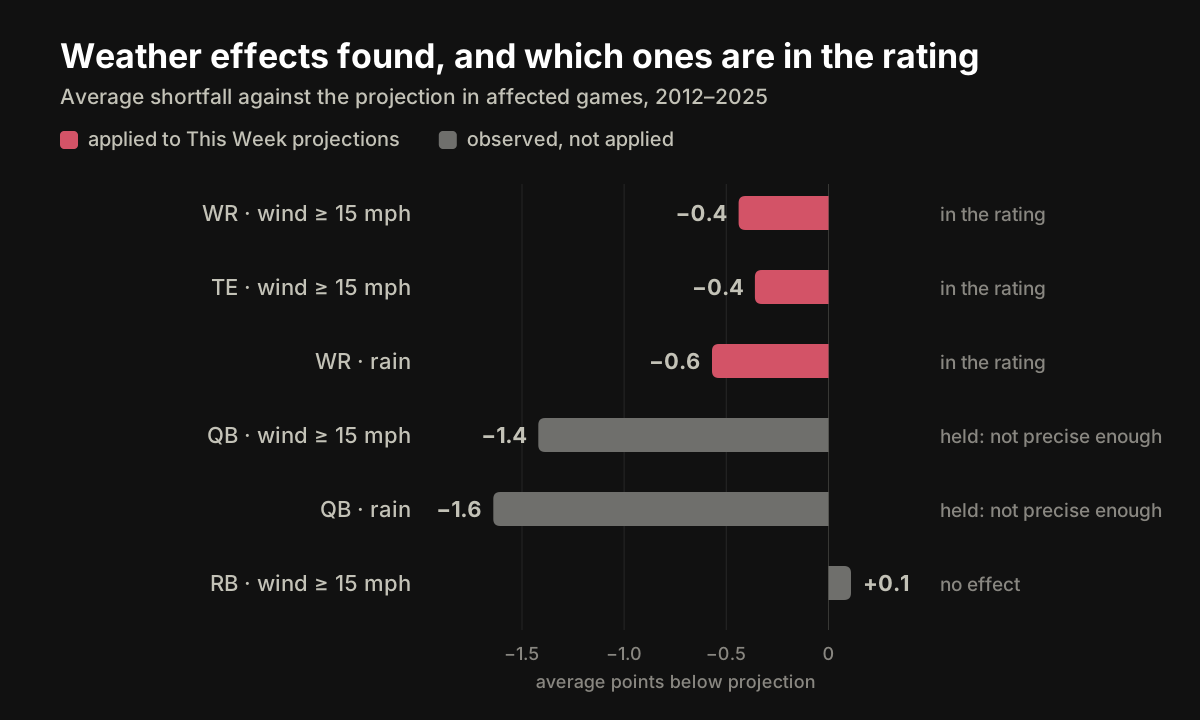
Wind of 15 mph or more hurts receivers and tight ends. About one outdoor game in eight reaches that threshold at kickoff. In those games the model ran high on wide receivers by 0.44 points and on tight ends by 0.36 points, and the effect pointed the same way in 11 and 12 of 14 seasons respectively.
Rain hurts receivers more than wind does. In games with rain at kickoff, receivers finished 0.57 points below expectation. That was negative in 13 of 14 seasons — the most consistent effect in the study.
| Condition | WR | TE |
|---|---|---|
| Wind ≥ 15 mph | −0.44 pts (11 of 14 seasons) | −0.36 pts (12 of 14 seasons) |
| Rain at kickoff | −0.57 pts (13 of 14 seasons) | no reliable effect |
| Average score, calm and dry | 5.6 | 3.9 |
| Average score, windy | 5.2 | 3.6 |
| Average score, rain | 4.9 | 3.7 |
What didn't
| Kickoff wind | QB | WR | TE | RB |
|---|---|---|---|---|
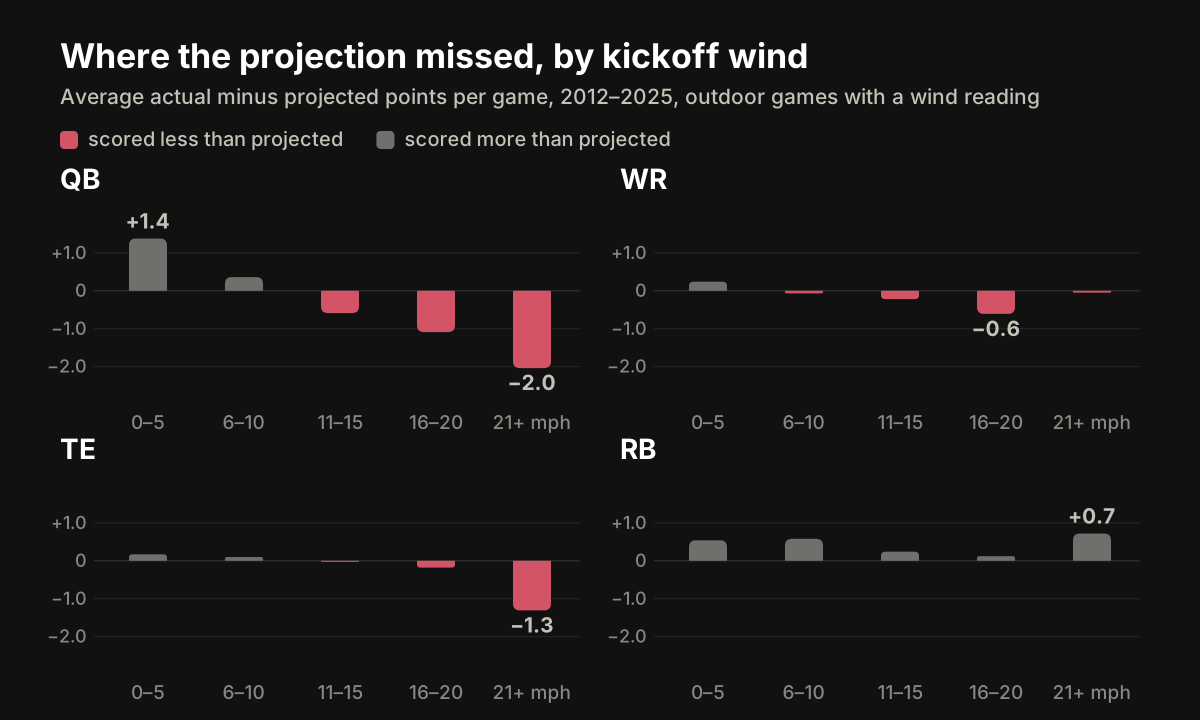
| 0–5 mph | +1.4 | +0.2 | +0.2 | +0.5 |
| 6–10 mph | +0.4 | −0.1 | +0.1 | +0.6 |
| 11–15 mph | −0.6 | −0.2 | 0.0 | +0.2 |
| 16–20 mph | −1.1 | −0.6 | −0.2 | +0.1 |
| 21+ mph | −2.0 | −0.1 | −1.3 | +0.7 |
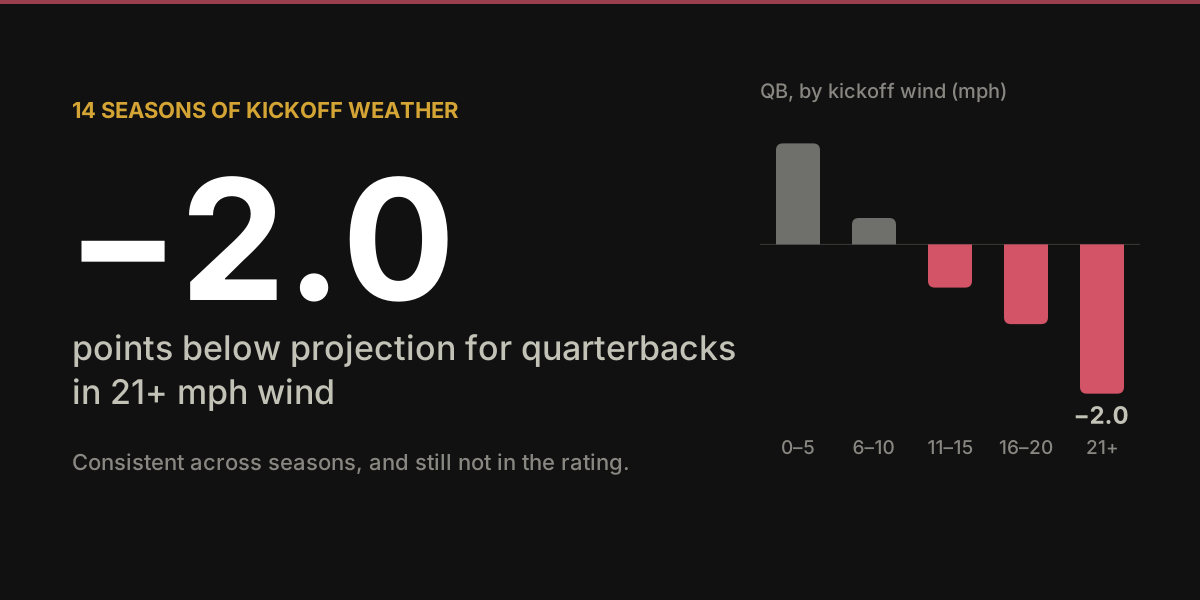
Quarterbacks show the biggest weather effect of all, and it is not in the rating. The pattern is clean: in calm air the model runs low on quarterbacks by 1.4 points; at 11–15 mph it runs high by 0.6; at 16–20 mph by 1.1; above 20 mph by 2.0. Rain looks the same — quarterbacks finish about 1.6 points under expectation. But quarterback scoring is noisy (the typical weekly miss is almost 8 points), the wind effect pointed the right way in only 9 of 14 seasons, and 480 windy quarterback games were not enough to size the number to the standard above. A real effect that cannot be sized precisely is context, not a rating. The AI Coach will say so — "historically about a point and a half in this wind" — and the number on the page will not move. It is first on the list to re-test after this season.
Running backs do not care about the weather. The folk wisdom says wind helps the run game. The data says the model's miss on running backs is flat from calm to gale: +0.5, +0.6, +0.2, +0.1, +0.7 points across the wind buckets. No rain effect either. There is a curious +1.3-point bump in the 163 snow games on record, which is exactly the kind of finding to distrust until it survives a few more winters. Reported, not applied.
The fancier versions were worse. A smooth wind curve instead of a 15-mph threshold hurt accuracy. Scaling the penalty by a receiver's depth of target hurt accuracy. Cold and snow dissolved into the wind effect once wind was controlled. The simple threshold — the same one the FantasyOmatic kicker model settled on years ago — is the right shape.
Opponent injuries
Injuries on the other side of the ball were tested the same way, using thirteen seasons of injury reports and defensive snap counts to measure how many starter-equivalents a defense was missing each week.
The direction is what any fantasy player would guess: a quarterback facing a front seven missing a starter scores about a point more than the opponent's season rating implies, and that held in 85% of seasons. But the opponent's rating already absorbs most of it, the leftover is small, and adding it as a feature made weekly accuracy worse for every position. It is not in the ratings, and the AI Coach treats it as talking-point context rather than a number.
Injuries on a player's own team are a different mechanism entirely — that is the vacancy system, which redistributes a missing starter's touches and targets to his backups.
What this means for your lineup
- The This Week projection for a WR or TE now includes wind and rain for outdoor and open-roof games, based on the National Weather Service forecast for the kickoff hour. Rain means a precipitation probability of 50% or higher.
- Nothing else moved. Rest-of-season ratings, playoff ratings, trade values and future weeks carry no weather term. There is no forecast to base one on.
- Where to look: the projection breakdown on any player page now has a Weather row when it applies, the Signal Dial folds it into the venue spoke, and the AI Coach cites it when it matters.
- A dome, a roofed stadium, or a game with no forecast counts as zero. Missing weather is never treated as calm and dry.
- Do not start a running back because it is windy. The data does not support it.
- Do not bench a quarterback on the number alone. The rating will not move for weather. If the forecast is ugly, that is a judgment call the projection is not making for you.
Weather is one of the circumstances Week Context accounts for. A two-minute explainer on how the ratings get made covers how Week Context, Player Rating and Defense Impact fit together.
Kickers and defenses
Nothing changed. The special-teams model has carried its own wind, dome and cold adjustments since it launched, tuned with the same walk-forward discipline. This study covered the positions that did not have one.
The fine print
The historical rain flag comes from the observed conditions at kickoff; the live one comes from a forecast, and forecasts miss. Schedule weather readings were sparse in 2022 and 2023. Wind is a single kickoff reading, not a game average. The whole study — data, code and every number above — is reproducible, and it will be re-run after this season. If a factor stops holding up, it comes out.
A half-point that can be defended beats a two-point adjustment that cannot.
Don't share this with anyone in your league.
Share with the people you want to see win.
Discussion
No comments yet. Be the first to share your take.